The mystery of the missing parents
A few years back when my children were young, I bought something on Ebay. I don’t remember what, but I had to pick it up early on a Saturday morning. I don’t remember how old the kids were either – maybe 5 and 3? Just know it was back when they were enthusiastic enough about getting up early on a Saturday morning that they came with me.
We went in the car, and got back just before nine. I opened the front door, and the kids - enthusiastic now to be home - charged in ahead of me, already explaining to Maria where we’d been and what we’d bought. And on the spur of the moment I made a near life-changing decision. With the key still in the lock I decided I wouldn’t go into the house, but would instead walk around the corner to the local shop, and pick up some breakfast. Presumably I already knew we didn’t have much in, and the shop did reasonably good croissants, which made for a nice weekend breakfast treat.

I may or may not have called out what I was doing – I don’t remember – but it wasn’t a concern. To be honest, I quite often went to the shop, and my relationship with Maria was such, that at this point me not being there for another twenty minutes didn’t upset her too greatly. For my part too, I was a stay-at-home dad, and it was rare to get a moment to myself in those days. Such that ten minutes to walk to the shop felt like a treat in itself. In fact it really did. I still recall the feeling of luxury to be able to browse the few aisles, nodding to other shoppers, without answering questions about which was my favourite Go-Jetter, or whether it was fair that one child had fractionally more strawberry yogurt than the other. I took my time, then paid at the till and walked home. Maybe twenty minutes had now passed. At the front door I slipped the key back into the lock. And that’s the moment I knew I’d fucked up.
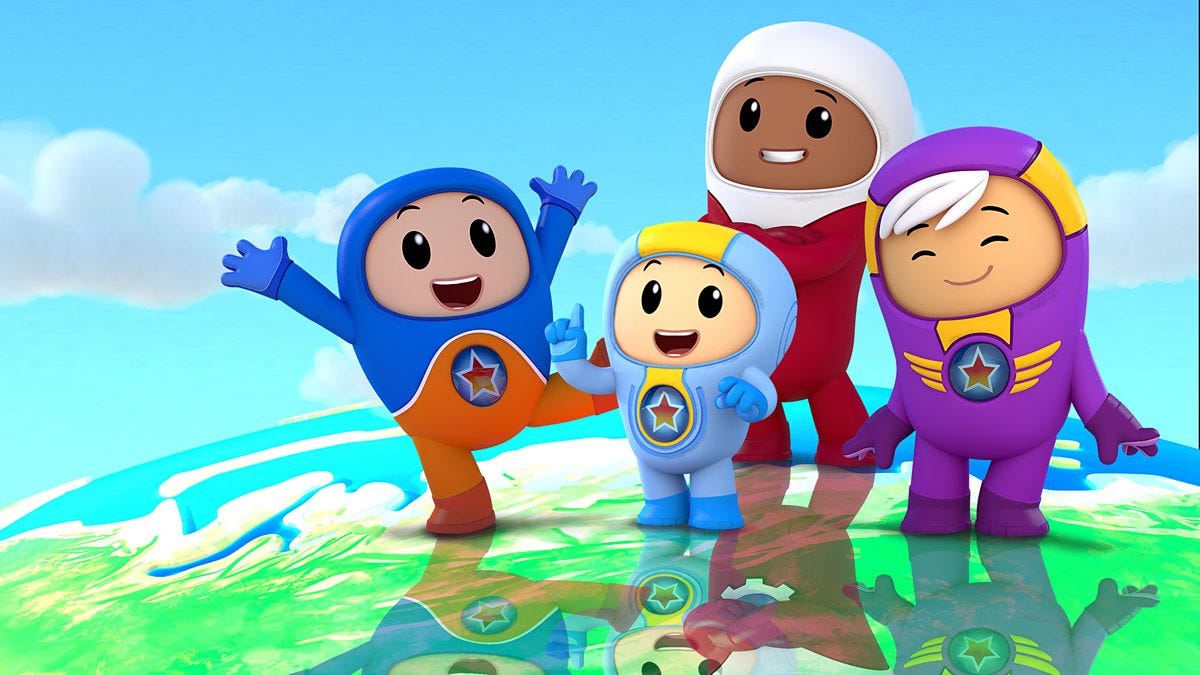
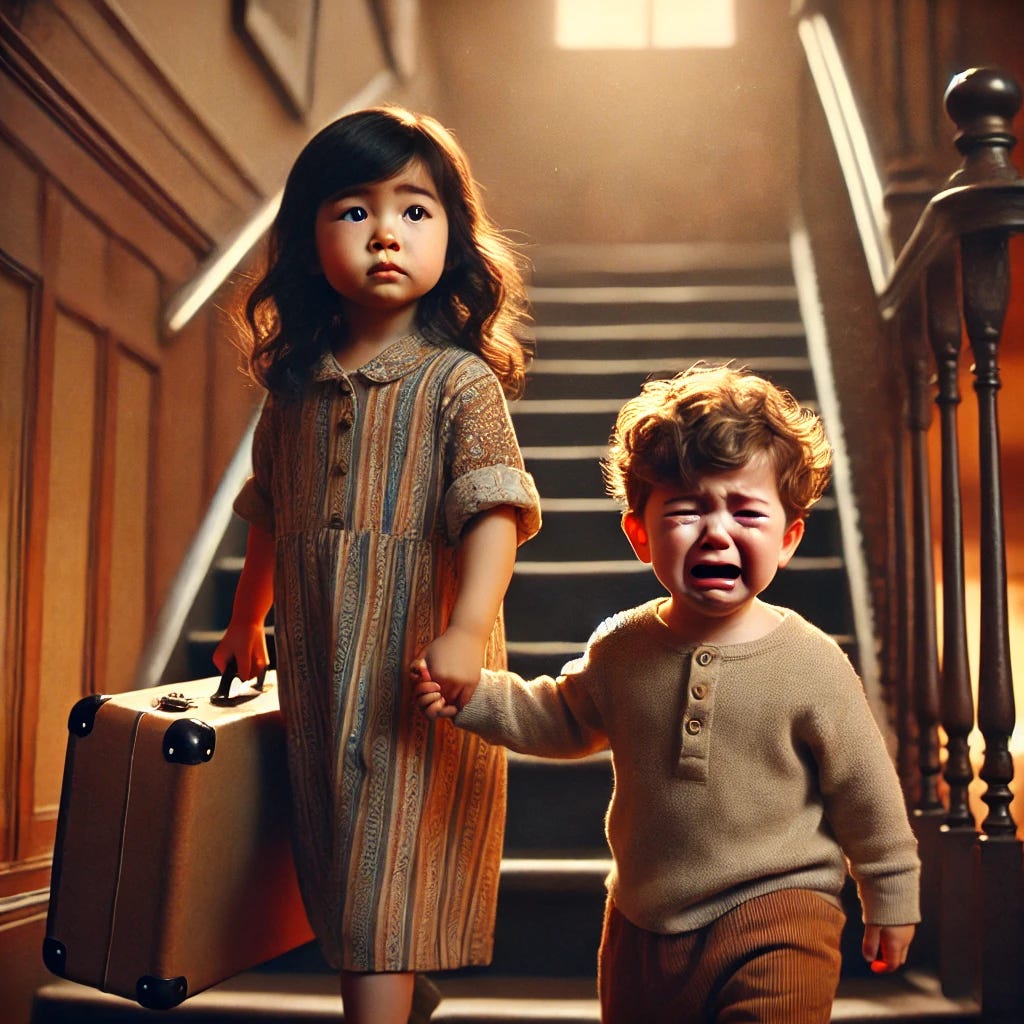
When I opened the door, the first thing I saw was my son, Rafa (he’s the three year old), trailing Alba (5) down the stairs. He was in floods of tears. She had a slightly more determined look on her face. They were holding hands, but each of them also pulled a suitcase. The moment they saw me both began crying, and they ran towards me, grabbing hold of my legs. What had happened - of course – is this. When I let them in the house, thinking that Maria was inside, she’d actually already left to go for one of her long weekend runs. So that the children had rushed ahead into the house, only for me to completely disappear without any warning, and for them to find themselves, suddenly and inexplicably, alone in the world.
When they stopped sobbing they eventually explained what had happened next. At first they’d thought it must be a joke – an impromptu game of hide-and-seek. They’d searched the usual places (we played a fair bit of hide-and-seek in those days). But they didn’t find me, and when they called out I didn’t come out, chuckling at my ability to outsmart mere children. So they searched the not-so-usual places too. The shed, which was full of spider webs and damp, because it was winter at the time. Obviously they didn’t find me there either, because at this point I was happily browsing biscuits in the local Co’op.
So next they found their suitcases, putting into action a plan that Alba takes most credit for today. They were going to go next door and live with our neighbour, Mike. Now Mike’s a lovely guy, but he doesn’t have kids and he wouldn’t be my first choice if adoption were on the menu. Nonetheless, he was going to be their new parent, starting immediately. Please note, the suitcases, which they had packed were both entirely empty apart from their favourite teddies. Next up was a note that Alba had written, explaining what had happened, and what they were going to do. But critically this note wasn’t written to us – so that we would know where to find them when we eventually got back. It was written to the elves, and just generally informed them that disaster had struck, and that they could be found, if needed in the future, at number 10, care of Mike, rather than number 8, care of Gregg and Maria.
In short, they’d made the decision, in half an hour, to completely give up on the life we’d been giving them, and which was generally based upon observable reality, and start an entirely new one, which wasn’t.
The reason I’m telling this story is that I’ve dipped into – via a very circuitous route – the world of quantum mechanics. How this happened is slightly relevant, and came about because of the book I published this year: The Lake House Children. It’s a novel, but it deals with themes that are not entirely disconnected with aspects of philosophy, neuroscience and the study of consciousness, and perhaps even quantum physics too. (Please don’t let that put you off, if you were thinking of reading). To write the book I had to do a lot of research into these topics, and thus my Google Suggested Articles, whenever I now go on the internet, is filled with these themes. And sometimes I’m distracted enough to read them. I read one this morning about the ‘Everett Interpretation of quantum mechanics’, and it reminded me of the morning I left my kids alone, for just half an hour.
At various times in my life I’ve tried to make sense of quantum theory, and then it fades away into the deep background of my life, along with my schoolboy understanding of long division. My sense is that most of us are like that. So apologies to those for whom a quick recap is genuinely unnecessary. For the normal folk, strap in:
The Everett – or Many Worlds Interpretation – is a theory proposed by Hugh Everett in 1957 that offers a way of understanding quantum mechanics without requiring wavefunction collapse. (Still don’t think you need a recap?) Instead it suggests that all possible outcomes of quantum mechanics actually occur, but in separate, non-interacting branches of the universe.
In the famous double slit-experiment a single photon of light appears to pass through two slits in a board unless and until it’s measured, and then it passes only through one. In the infamous thought experiment using Schrödinger’s poor cat, it’s both dead and alive in the box, until the great scientist takes a look.
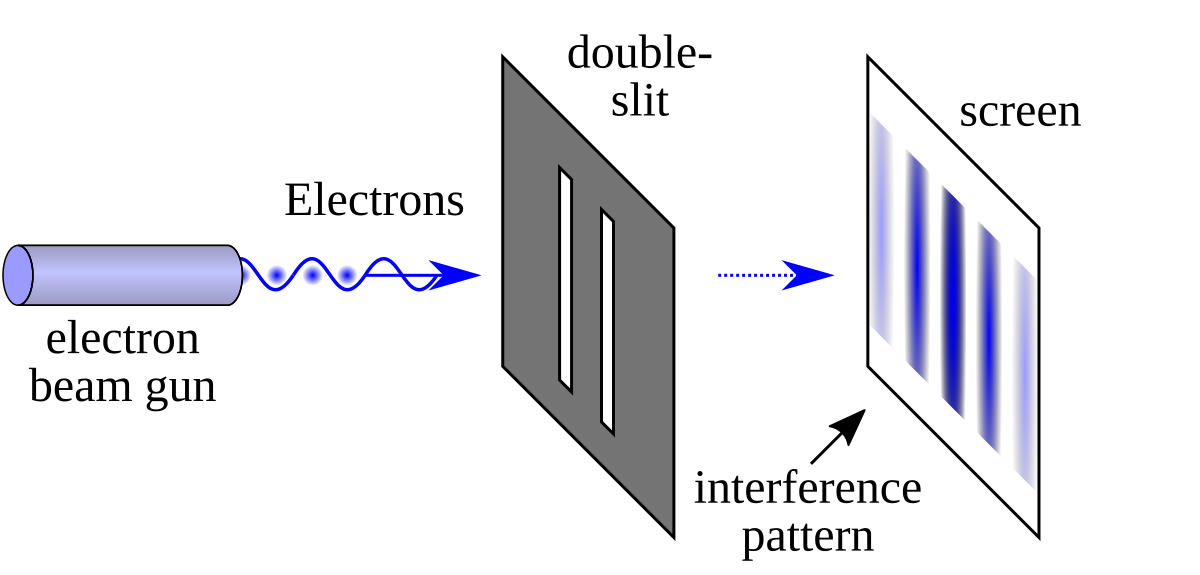
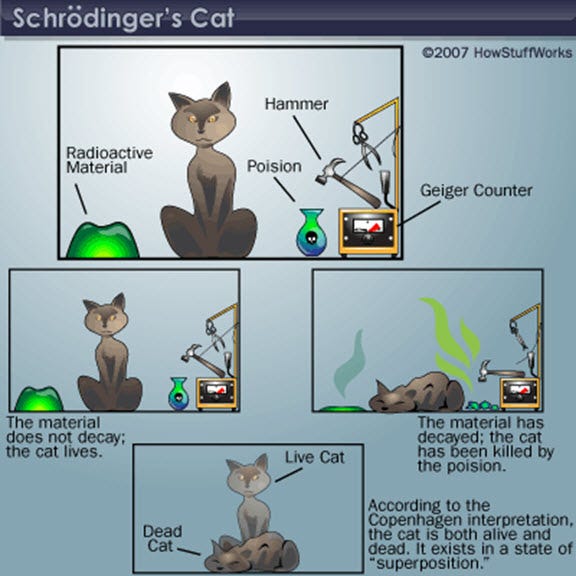
I find I’m almost able to let such ideas enter and then exit my brain without really caring, noticing or understanding what they mean, so here’s an analogy I worked up with the help of ChatGTP (which explained it to me).
Imagine I decide this morning to have eggs for breakfast instead of toast. The Many Worlds Interpretation tells us that, when I do this the universe splits into two versions of itself, and both then continue to exist: There’s a world where I have the eggs, and then live out my natural life, and another where I have the toast, and then suffer all the consequences that decision brings. But there’s more. When I decided to have eggs, that created a new version of you, and your decision to read this email, instead of going onto the internet to find something more interesting - created a new version of me. I mean, come on. (Note – for any actual quantum physicists out there, I am aware I’m simplifying things a bit here, and potentially glossing over explanations that try to bridge the gaps in the theory. Most notably the Many Worlds Interpretation implies all possible versions of you already exist, but that hardly make it any easier to swallow.)
And that’s the problem. It’s just absolutely batshit crazy. On a similar level of insanity – and possibly exceeding – my children’s decision to go and live with Mike after writing a note to the elves and packing their suitcases with absolutely nothing (again, sorry Mike). It feels as though the quantum physicists have been left unsupervised for considerably more than the half hour I left the kids for, and they’ve totally lost the plot.
Of course I am aware that there are differences here. Quantum physicists are some of the smartest people on the earth, and I’m not. But it is also unavoidably true that the ‘solution’ the Everett interpretation provides has some enormous plot holes.
The point I’m trying to get to is this. If this is – still today – perhaps the leading theory to solve the problem created by quantum mechanics, then the problem it’s trying to solve must be absolutely vast. From our human perspective the single universe we can see it unfathomably enormous, but to insist there must be an infinite number of other universes, each equally huge and forever splitting into more and more branches… Are you guys quite sure about that?
So – like my kids trying to solve their sudden-abandonment-problem – what are the physicists actually trying to solve? It’s the ‘observer’ effect.
In quantum mechanics, particles exist in many possible states at once (like being in two places at the same time), but when we look at them, we only ever see them in one place. The big mystery is why and how ‘looking at’ something (or measuring it) makes all the other possibilities disappear.
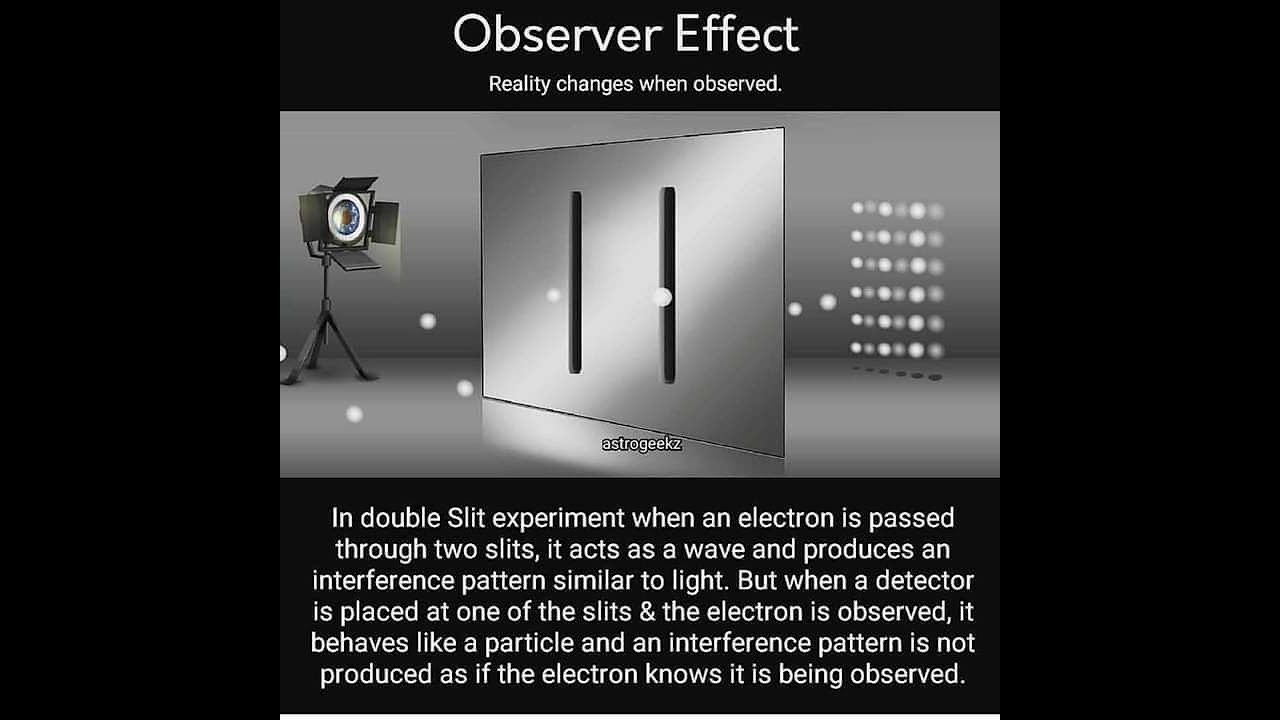
The weirdness is that just by observing something, you seem to change it. Before you look, a quantum particle is in a "superposition" of all possible states (like Schrödinger’s cat being both alive and dead at the same time). But when you observe it, it "picks" one state and the others vanish. The problem is: why does observing have this effect? It eerily implies there might be something special about the consciousness of the entity observing. That's what interpretations like Many-Worlds try to explain away.
Which in turn brings me back to my latest book – The Lake House Children. I had a lot of trouble writing this, because it felt at times like it was anti-science, or I was challenging ideas way above my station. I don’t want to say too much about what it's literally about, because that kind of ruins the read, but as I’ve said it touches on philosophy, consciousness, psychology, neuroscience and perhaps a spot of quantum mechanics. What I tried to do was layer all this into a page turning thriller – I’m nothing if not absurdly over-ambitious.
But just occasionally I have a moment where I don’t conclude that I must have failed, because science has a completely solid handle on the nature of reality, and it’s utterly perverse of me to think otherwise. And in those moments I realise that this book is actually quite a good way into thinking about some of the most profound questions any of us can, and ever will, face. Which is yet another absurdly-optimistic hope I had when writing the book. So even though I haven’t pushed it terribly hard, this blog post is, in the end, a call to anyone out there who hasn’t read it, but might like to give it a try. Christmas is coming up – you may have noticed – and maybe it would make a good present for the neuroscientist, philosophy professor or quantum physicist in your life? Or maybe just a present for yourself? It is, at times, a bit bonkers, but then isn’t that just the same as life, the universe, and everything? And if nothing else, the cover is very pretty.
OK – sorry I haven’t written in a while. I have been (moderately) hard at work working on another book, and I’m pleased to report that I have a first draft finished for The Follower, which I have to turn into a decent second draft after Christmas, but in the meantime I’m sort of done for the year and we’re looking forward to going skiing in the Pyrenees. Let’s just hope I don’t accidentally leave the children there…
Happy Christmas all!
Gregg
Read The Lake House Children on Amazon
Listen to The Lake House Children on Audible

PS: I also asked ChatGTP to make me an image of how the children might have looked, coming down the stairs as I walked in the door. It’s missed by a mile with Alba, but I have to say the expression on Rafa’s face is pretty much as I remember it…
PPS: Here’s the article that sparked this post, a Google blog on its new quantum chip which includes the line: “It lends credence to the notion that quantum computation occurs in many parallel universes, in line with the idea that we live in a multiverse”:
https://blog.google/technology/research/google-willow-quantum-chip/
Originally published on Substack · View the original →